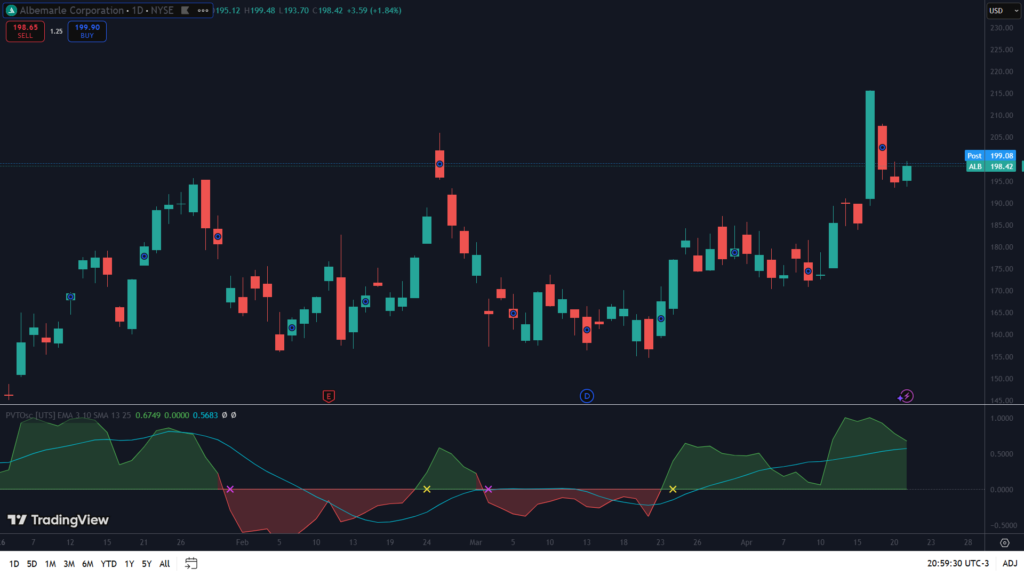
One thing the market has taught me is that looking at charts without fundamentals is useless, and looking at fundamentals without timing is a trap. Over the years, I have developed my own screening process: simple, direct, and objective.
My method filters for high-quality companies and only triggers a “buy” once the market confirms the direction. I don’t try to predict; I wait for the perfect alignment of quality, growth, valuation, and price action.
The Core Principle: Quality First, Trend Second
The logic is mechanical. First, I run a “fine-tooth comb” to find fundamentally sound businesses. Then, I only enter a trade when the chart shows me an established uptrend. I am looking for the sweet spot where value meets momentum.
My Fundamental Screening Criteria
Here are the specific filters I use in my daily routine:
1. PEG Ratio (Price/Earnings to Growth)
- Filter: Minimum of 0.01 (No negative values).
- Why: This tells me if a stock is overpriced or undervalued relative to its earnings growth. It’s the ultimate balance between value and expansion.
2. P/B Ratio (Price-to-Book Value)
- Filter: Maximum of 1.5.
- Why: I look for assets that aren’t excessively “stretched” compared to their net asset value.
3. EV/EBITDA
- Filter: Between 0.01 and 15.
- Why: This helps avoid companies with distorted valuations or those that are too expensive relative to their cash flow generation.
4. Net Debt / EBIT
- Filter: Between 1 and 3.
- Why: Financial health is non-negotiable. A company must have manageable debt that is well-covered by its operational earnings.
5. Net Margin
- Filter: Minimum of 10%.
- Why: This separates efficient companies from those that generate high revenue but keep very little profit. High margins provide a safety cushion.
6. 5-Year Earnings Growth (CAGR)
- Filter: Minimum of 10%.
- Why: Consistent earnings growth over a 5-year period is the fuel that drives stock prices higher in the long run.
7. Average Daily Trading Volume (ADTV)
- Filter: Minimum of $1 Million.
- Why: In the US market, liquidity is king. Without at least $1M in daily volume, you risk “slippage” and might struggle to exit a position during high volatility.
The Final Technical Filter: When Does the Chart Matter?
Many investors make the mistake of buying a stock just because the numbers look good. I don’t. I wait for the market to prove it “agrees” with the fundamentals.
My final technical entry requirement is binary:
- Price must be above the 200-day Moving Average.
- A confirmed uptrend must be in place.
I only deploy capital after this confirmation. This model solves two classic problems: it prevents me from buying a “value trap” (a good company in a free fall) and it prevents me from buying “trash” just because it’s pumping.
Conclusion: Less Emotion, More Process
This screening isn’t a magic wand, but it is a logical, replicable, and consistent process. It allows me to cut through the market noise and focus on high-probability setups.
If you are feeling overwhelmed by the thousands of stocks on the NYSE or NASDAQ, start using clear filters. Less emotion, more process. The market will decide the rest, but you decide the risk you are willing to take.